
Occupational Noise and Hearing Services
One-stop service for all your hearing and noise assessment needs — delivered directly to your workplace in NSW, QLD and SA.
Mobile Audiometric Testing with PPE Fit Testing
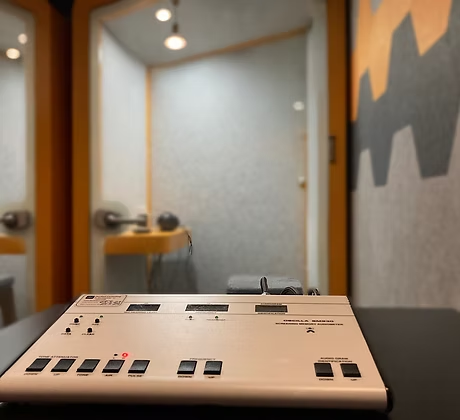
Try our on site visiting service — custom fitted mobile clinic with a dual booth pantech truck, giving double the service capacity. Your workers stay on site with minimal downtime and no off-site medical appointments or travel time to clinics.
This service covers both baseline testing (within 3 months of commencing work in a noisy role) and ongoing monitoring testing, as required by Australian WHS legislation and the AS/NZS 1269.4 standard. Screening results are always discussed with the worker, as required under the Standard.
- Custom fitted mobile clinic — dual booth pantech truck
- QR code based sign-on and reporting system
- Optional HPD/PPE fit testing
- Gold standard reporting, analysis and risk debrief with expert included
- Calibrated audiometric equipment — AS1269.4 compliant
- Same day results
What to Expect
- 1We arrive at your site with all equipment — no preparation needed
- 2Workers sign on via QR code — fast, paperless
- 3Workers attend individually for a 10–15 minute test
- 4We test hearing across multiple frequencies
- 5Results are compared to previous tests and discussed with the worker
- 6Reports delivered same day
Noise Assessment Scope
Noise Assessments
Comprehensive assessment of worker noise exposure to determine WHS legislative obligations
Noise Surveys
Detailed mapping of noise levels across your site to identify hazardous areas
Plant & Equipment Certification
dBA certification for individual items of plant or machinery using Class 1 instruments
Noise Dosimetry
Personal noise dose measurement for workers with variable or intermittent noise exposure
AS1269.0 Assessment Reports
Formal reports that clearly determine whether workers are "noise affected" under WHS legislation
Occupational Noise Assessment
Occupational Noise Consultants now available for noise assessments, noise surveys, and plant and equipment dBA certification — all conducted with calibrated Class 1 instruments by Hottinger Brüel & Kjær (HBK), Denmark.
Not sure if your workplace triggers the obligation for audiometric testing? A noise survey or noise assessment guided by Part 1 of AS1269.0 (Occupational Noise Management) will clearly define whether a worker or role is considered “noise affected” under WHS legislation.
Enquire NowAudiological Testing
Certified Practicing Audiometrists now available for specialist audiological assessment beyond routine occupational screening. We use portable audiological testing equipment from Oscilla (Denmark) and MedRx USA — the same instruments used in audiological clinics globally.
- Pre-employment / fitness for work hearing assessments (mines, policing, aerospace)
- Commercial Drivers Licence (fitness to drive) audiological testing
- Full audiological assessment (GP reports)
- Bone conduction, tympanometry and speech audiometry
- Gold standard HPD/PPE fit testing using Real Ear Attenuation Thresholds (personal attenuation rating reports)
When is Specialist Testing Required?
Pre-employment
Industries with specific hearing fitness standards — mining, policing, aviation, aerospace and defence
Commercial Drivers Licence
Audiological component of CDL fitness to drive assessments
Complex presentations
Workers with conductive loss, tinnitus, or presentations that require more than routine screening to assess
HPD Fit Testing
Verifying that hearing protection devices actually protect individual workers to the required level in their specific noise environment
GP / Medico-legal reports
Full audiological assessment reports suitable for general practitioners and medico-legal purposes
Program Components
Baseline Testing
Initial hearing assessment within 3 months of commencing work in a noise-exposed role
Periodic Monitoring
Annual or biennial follow-up tests — annual is best practice and strongly recommended under AS1269.4
Threshold Shift Flagging
Automatic identification of workers with significant hearing changes and recommended next steps
Referral Recommendations
Clear guidance on workers who require further audiological assessment or medical review
Records Management
Longitudinal records maintained for each worker — audit-ready for WHS inspections
Hearing Conservation Programs
A baseline test within 3 months, then monitoring at a minimum of every 2 years — it's now law. Australian WHS legislation requires employers to implement an ongoing hearing conservation program for workers exposed to hazardous noise levels.
We design and manage ongoing testing programs that track individual worker hearing health over time, ensuring you remain compliant and can detect early signs of noise-induced hearing loss before they become irreversible.
Enquire NowCompliance Reporting
Every test we perform is documented with a comprehensive report — written in plain language, suitable for safety managers, individual workers and WHS regulatory audits. Designed to satisfy WHS record-keeping requirements including the 30-year retention obligation.
Individual Worker Reports
Each worker receives a personal audiogram showing their hearing thresholds across tested frequencies. Results are discussed with the worker on the day, as required under AS1269.4.
Site Summary Report
An overview of all workers tested, including flagged threshold shifts, recommended actions and referrals. Suitable for WHS documentation and regulatory audits.
Longitudinal Tracking
Repeat test reports compare against prior results to identify changes in hearing thresholds. Records maintained in our QR code-based system — audit-ready at any time.
Not Sure What You Need?
Call us on 1300 414 260 or send a Quick RFQ / EOI — we'll ask about your workforce, noise exposures and current arrangements, and recommend the right approach with no pressure to commit.
Email info@hearingatwork.com.au or call 1300 414 260
Looking forward to assisting.